One developer. One month. Zero hand-written code.
Thistle is a parenting support platform for families raising children with unique behavioral and sensory needs. It uses AI to deliver personalized daily guidance, weekly summaries, and on-demand advice grounded in occupational therapy literature and real clinical practice — not generic chatbot output.
It was built by one developer, from first commit to live beta users, in one month. See it live at thistleguide.com.
The Timeline
It started with a simple question: can I build a safe, useful AI logging tool for our own family? An afternoon of tinkering proved the concept worked. A conversation with a practicing occupational therapist confirmed the idea resonated — no conflicts, no safety concerns.
After one evening spent on market research and business planning, serious development started on a Sunday. By Monday evening — roughly 10-12 hours of total development time — a fully functional application was ready for review.
The app ran internally for two weeks while we iterated at full speed with no external pressure. On March 8th, we brought our OT in as the first outside user. By mid-March, the first wave of beta testers followed.
One month after that first real commit: a closed beta with active users, an invite and attribution system, and a production platform handling real family data every day.
What Was Built
Thistle is a full production platform.
Parent-facing application:
- Onboarding and child profile creation
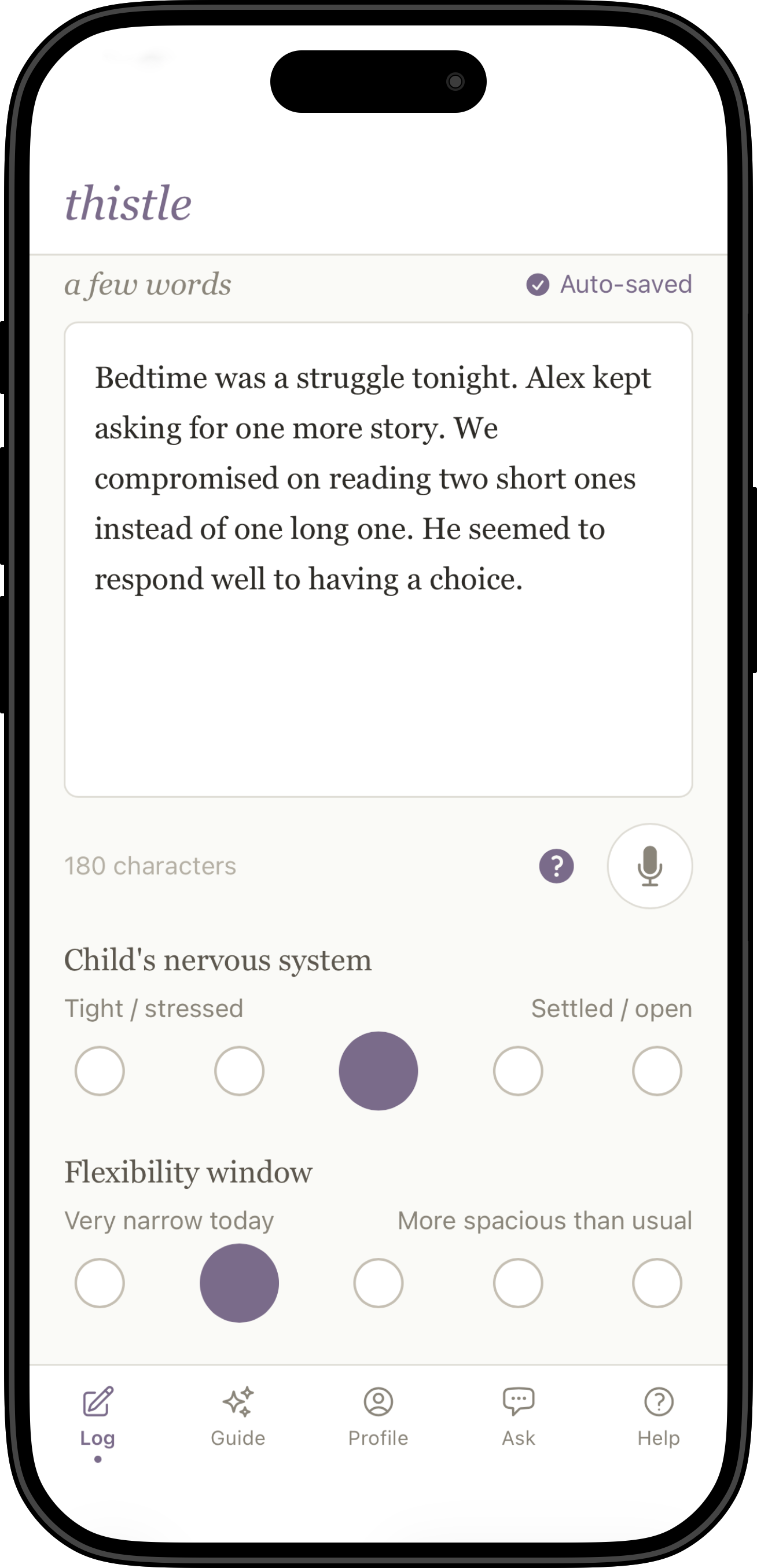
- A daily logging interface designed for exhausted, time-strapped parents
- AI-generated daily guides and weekly summaries delivered on a managed schedule
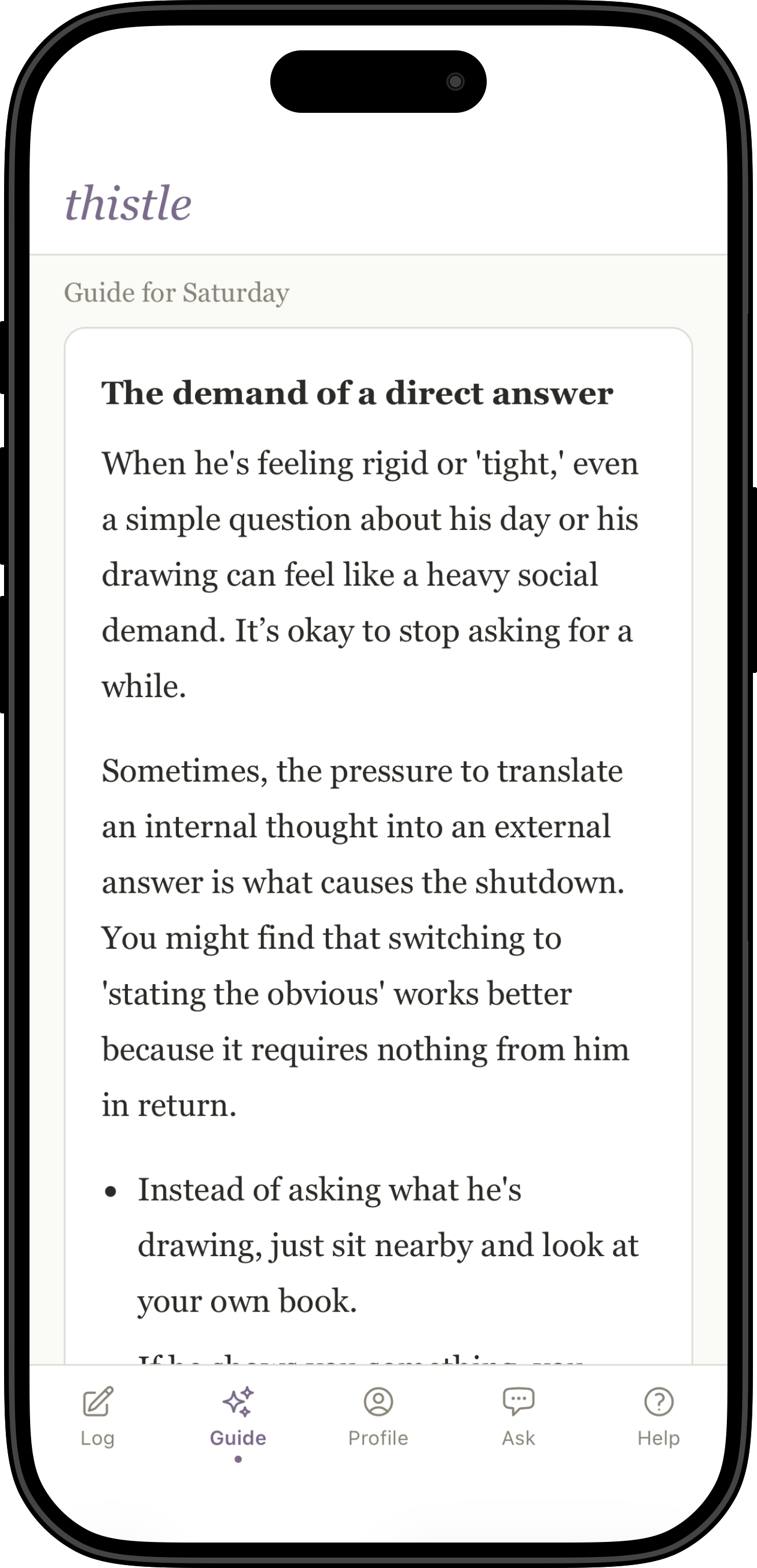
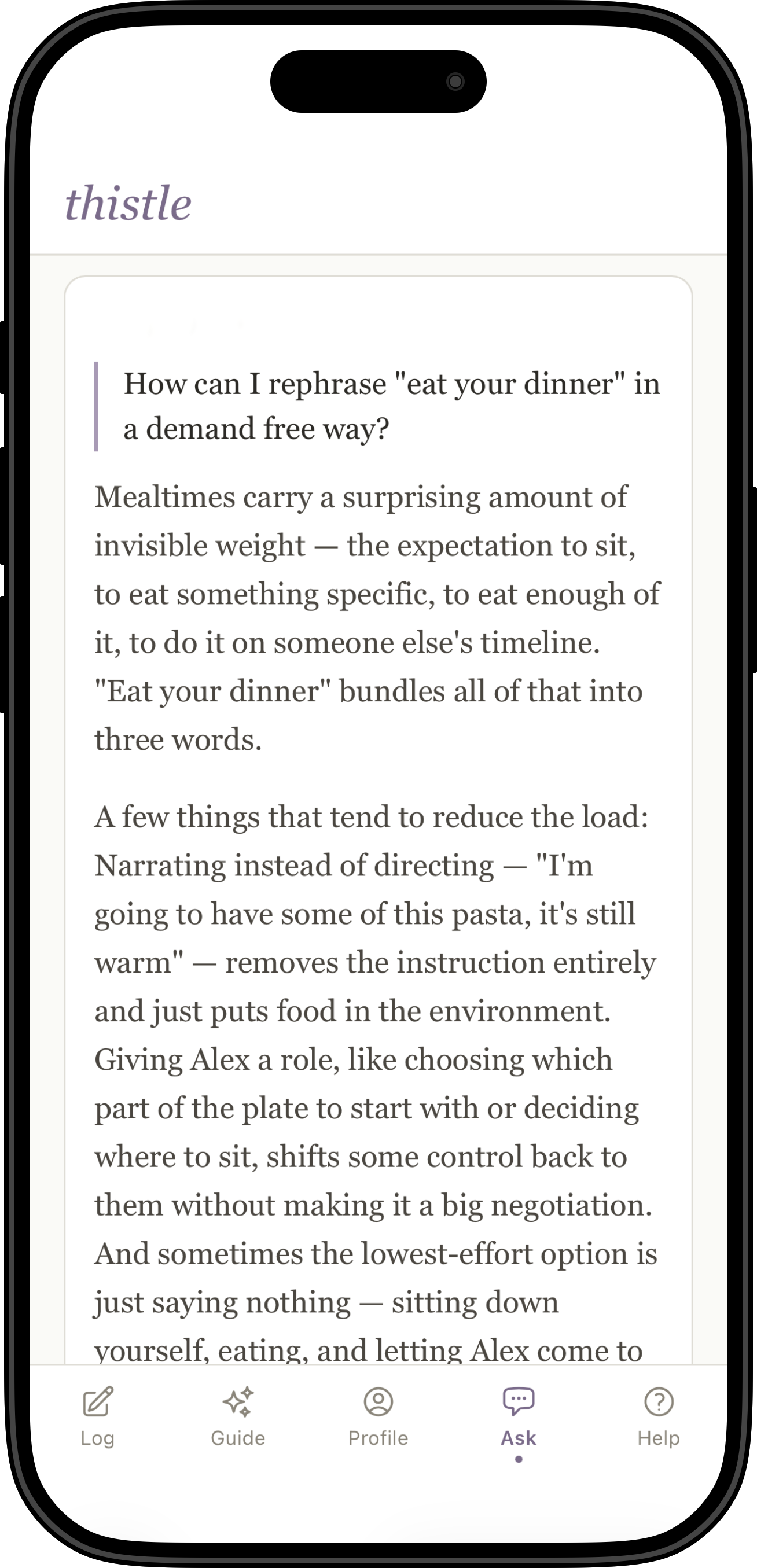
- A “Quick Ask” feature for immediate, context-aware advice — specific to a family’s situation right now, not tomorrow morning
AI pipeline and tooling: Custom integration layer built on AshAI and LangChain. Usage and cost monitoring. Prompt tuning and temperature controls. A prompt development workbench, heavily customized from open-source foundations to fit the specific needs of a clinical-quality AI product.
Quality and safety infrastructure: AI-generated output is monitored at four distinct points across the LLM pipeline. Every piece of content is checked before it reaches a parent. This is non-negotiable when your users are stressed families making real decisions about their children.
Admin and operations: End-to-end visibility into every process involved in collecting, processing, and delivering data. Standard external integrations including Stripe. Custom invite flows and attribution tracking for closed beta management.
Production infrastructure: PWA with passwordless and OTP authentication. Security policies, audit logging, and monitoring provided by the Elixir/Phoenix framework stack, hosted on Fly.io.
The Development Approach
Thistle was built entirely through AI-driven development — no human-authored code. Here’s what that actually looks like in practice.
It starts with a concept spec, not code. A typical feature begins as a two-to-three paragraph description written in plain English. Code specifics are described in natural language rather than dictated as syntax, because the AI produces better results when it can find its own path to a correct solution.
Be opinionated about outcomes, not about how the code itself is structured, as long as it’s efficient and safe.
Planning before building. That concept spec gets turned into a detailed execution plan by one AI agent. Depending on complexity, that plan might be ready to execute immediately, or it might go through a review cycle — passed to separate agents for security review, performance analysis, and holistic fit before coming back to the primary coding agent for a final review and build.
Parallel but hands-on. Typically one to three AI processes run simultaneously. The constraint isn’t the tooling — it could comfortably handle six to ten — it’s the preference for staying deeply engaged with every build. Keeping the work on track, making sure it does the right thing efficiently, catching problems early.
Testing is no longer the bottleneck. Creating comprehensive test coverage used to take longer than building the feature itself. Today, a completed feature goes to a separate AI agent that generates thorough test cases and validates coverage. What was once the most time-consuming part of development is now one of the fastest.
Knowing when to start over. When an AI agent session is working well, it’s remarkably productive. When it’s not, it can be actively counterproductive. The critical skill is recognizing a bad session early and being willing to throw the output away and regenerate. Because the volume of output is so easy to produce, it needs to be just as easy to discard.
The Role of Domain Expertise
The development team is one person. The product team is three.
Amelia and our daughter’s occupational therapist provide non-technical domain expertise that shapes every aspect of the product. They are the first line of quality control — especially for AI-generated output. Every piece of output is grounded in clinical literature and sound practice — not plausible-sounding hallucinations.
This shows up most clearly in prompt development and model selection. Since the start of the build, the system and background prompts have gone through an average of eight to ten iterations per day. And it’s not just prompt engineering — it’s selecting the right LLM for the right job. Sometimes that’s Claude, sometimes it’s GPT or Gemini, sometimes it’s a local model. Figuring out which model produces the results you need for each specific task is a critical part of the process.
For Thistle, this work — prompt iteration and model selection — is where the most sustained effort goes.
Beyond prompts, domain experts handle feedback collection, beta user communication, and prioritization of what to build next. They are the bridge between what the technology can do and what families actually need.
Why This Approach Works
A lot of people can get to a demo. The difference between a demo and a product is engineering discipline.
Designing for iteration from day one. The architectural decisions made in week one determine whether you can keep building in week five or whether you’re staring at a full rewrite. Standards around code structure, testing, and modularity need to be established early — not because the code itself needs to look a certain way, but because without that discipline, every third change triggers a cascading refactor. The AI will happily build you a V2 from scratch. A well-architected V1 means it doesn’t have to.
The AI makes the building fast. Experience makes it hold up. Thistle isn’t the first production application built with this workflow — and each build sharpens the process. Framework selection matters. Elixir and Phoenix are exceptionally well-suited to AI workflow development. Tools like Tidewave and AshAI provide real leverage. But choosing and integrating those tools correctly — and knowing how to structure an application so that AI-generated code remains maintainable — requires judgment about architecture and tradeoffs that the tools don’t provide on their own.
The results speak for themselves.
By the Numbers
| Time to working prototype | One afternoon |
| Time to full application | ~12 hours across two days |
| Time to first external user | Two weeks |
| Time to active closed beta | One month |
| Development team | Solo developer |
| Monthly AI tooling cost | Under $250 |
| Tech stack | Elixir, Phoenix, AshAI, LangChain, Fly.io |
| Human-authored code | Zero |
Live Usage (Closed Beta)
| User logs submitted | 185 |
| Daily guides delivered | 207 |
| Weekly summaries generated | 25 |
All data from real families during an invite-only beta period. No synthetic or test data.
About Winter Green Solutions
Winter Green Solutions is a bespoke software design and development shop based in Burlington, Vermont. We build production-quality applications with AI-augmented development workflows — the same approach used to build Thistle.
Interested in how this approach could work for your project? Get in touch.